


CD & DVD
A Masterpiece Full of Secrets: Morimur
02.04.2026


World-renowned orchestra conductor, violinist, and pedagogue Christoph Poppen has penned the secrets behind Morimur for Andante readers.
It was end of the 1980s that I happened to meet Professor Helga Thoene on the street. She seemed very excited and asked me whether I had a few minutes to stop by, so that she could show me something incredible. She then showed me the first page of Bach's C major sonata for violin alone, where she suddenly discovered various phenomenon, which indicated that Bach was referring to the Bible text about the Holy Spirit at Pentecost. In a way, that was not surprising, because we already knew that the theme of the Fuga is based on the Choral Komm Heiliger Geist (Come Holy Spirit). Already Nathan Milstein had told me that in a lesson...
From then on, I visited her regularly to witness the amazing progress in her research, mainly using numerology, a phenomenon which at Bach's time was very common. It was a well-known fact that Bach had used it in works like St. Matthew's Passion or others. But no one had ever published research on the sonatas and partitas for violin alone.
The numerology system is somehow easy to understand. Letters are turned into numbers and other way round. A is 1, B is 2, 3 is C, and so on, but following the old German alphabet and the old German writing, which was used at Bach's times. Like this, it was possible to translate music, which you can always define by numbers (rhythm, intervals, number of notes...) into text and other way round.
The discoveries which Helga Thoene made during these times were thrilling. On one hand, she discovered Bach's signature and even the name of his wife and the initials of their children in the score. On the other hand, everything seemed to have a religious context. Helga Thoene studied the personal copy of Bach's Bible, where apparently, he marked various passages, which she found translated into music in the sonatas and partitas.
This all was incredibly impressive, but completely theoretical. One could read it and talk about it, but there was no way of hearing it. But then the next step happened when she discovered choral fragments in the violin works, hidden somehow against the rhythm of the bars. The phenomenon is to be seen in all fugas and other movements, and mainly in the Ciacona of the d minor partita.
One must say that it would be easy to somehow collect the notes for a certain song in every composition of the world. If you wait long enough, you will always find the next necessary note to build the melody. But in this case, the situation was different. All the choral fragments, which she found, were fully harmonized. With other words, one could sing these choral parts with the violin music without adding or changing any note. The phenomenon was stunning. At that moment, we started to look for possibilities to make this approachable for an audience. We started out by adding a second violin, which was playing parts of these covered chorale lines, while I was playing the original text. At that time, Prof. Thoene gave many lectures, where we worked together, and people were very moved by the result. The next step was that we needed more than one additional line, because there are so many chorales happening at the same time. Then we tried working together with two boy singers from Dresdner Kreuzchor. They were amazing, because to sing all these chorales against the beat of the real music is quite difficult. But we were able to make a first recording with these two innocent voices singing chorales while I was playing the original text.
With this recording, one day I went to Manfred Eicher, the founder and CEO of the label ECM. He was so impressed and overwhelmed by the phenomenon, that he offered me to think about a real professional recording, and left it up to me to suggest some singers. I thought a long time about it and then came up with the idea of asking the famous Hilliard Ensemble. I travelled quite a long time to meet them after a concert, and even before we started to work, one of them said “This is nothing for us, this is not even a real score”. But luckily, another member of the ensemble was polite enough to say “Now he has travelled so far, let's give him a few minutes to at least try...” We started the Ciacona, without any interruption going to the end - and then they were so enthusiastic, all saying “We have to do this, we must find a way of recording it”. Then another layer of work started, because we wanted to focus on the Ciacona, not including other works of the six sonatas and partitas. Therefore, finally, we came up with the idea to record the original text of the violin partita, and the original complete chorales, which were included in Bach's writing of the Ciacona. At the end of the recording, we presented the complete version of the piece, including the chorales. We spent a lot of time recording it in a beautiful church in Switzerland being aware that this was a very precious and unique phenomenon, but nobody expected that there would be many people being interested in a recording of a Bach partita with baroque violin. But then the opposite happened. The recording was in the American classic charts for one year, and from all over the world we received requests to perform this in public. This was something we hadn't even thought about before, but we decided to represent the same context which we had recorded, and it was a huge success. We did concert tours all over the world, and literally hundreds of thousands of people have been listening to this performance or recording over the years.
I compare the phenomenon to a situation which is easy to imagine: You grow up in a place where you have a wonderful Cathedral or Mosque, where thousands of people go in and out and feel at home. Then suddenly, someone puts a spotlight to a dark place in the ceiling, where you discover the most beautiful painting of the church. It has always been there, but nobody ever discovered it.
Now we must talk about the context: Of course, the chorales have texts, and it is always the question which verse Bach might have been thinking of, while incorporating the text while including the melody. But Helga Thoene looked at it like at a big puzzle, and put things together in different ways until it made clear sense. At the same time, she continued working on the information based on numerology in the Ciacona. She came up with the clear fact, that Bach composed this work after the sudden death of his first wife, Maria Barbara, and it is talking about death and resurrection. The three big parts of the Ciacona seem to be dedicated to Father, Son, and Holy Spirit, and there is endless information about detailed description of Bible texts. The general meaning may be resumed in a way which says “We are giving our lives in the hands of the eternal God and know that everything will be transformed into a new reality in bright, bright light”.
There is a book by Helga Thoene Ciacona, Tanz oder Tombeau where she describes in detail her discovery. But, if you want to forget about the whole context, just listening to this wonderful music, it is always rewarding, consoling, and energizing.
I will always be deeply grateful that I was part of the development of this phenomenal research, that I was part of the recording and that I have unlimited memories of deeply impressive concerts with the Hilliard Ensemble all over the world.
Christoph Poppen
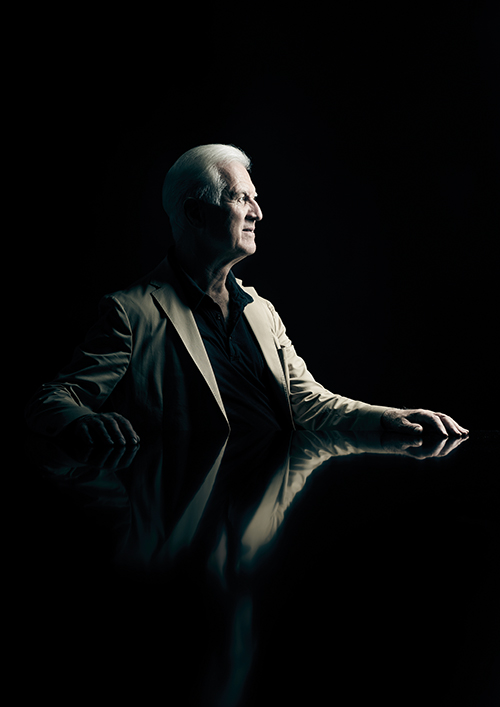
Christoph Poppen ©️ Matthias Baus
Morimur
Christoph Poppen
The Hilliard Ensemble
ECM NS 1765
Recording: Eylül 2000, Propstei St. Gerold
BENZER HABERLER


-
- ANDANTE ONLINE
- E-Issue
- This month's Andante
- Previous issues
- Point of sales
- Masthead
-
- REVIEW
- Hi-Fi
- Books
- Concerts & Opera
- CD & DVD


