


NEWS
50 Years of The Schubertiade Schwarzenberg / Hohenems
03.04.2026


The Schubertiade in Schwarzenberg and Hohenems will celebrate its 50th anniversary in 2026. With its dense programme and around 35,000 visitors annually, it is considered as the world’s largest and most prestigious festival dedicated to Franz Schubert. Since 1976, the leading artists of lieder recitals, as well as of piano and chamber music, have gathered here before an international audience — united by a clear artistic vision: “to present the works of Franz Schubert in exemplary performances within an intimate setting.” The Schubertiade has remained consistently faithful to this founding idea of Hermann Prey. To this day, the extensive oeuvre of Franz Schubert remains at the centre of the festival, with lieder recitals, piano recitals and chamber concerts forming the core of the programme. The program is complemented by works of other composers, primarily Schubert’s predecessors, contemporaries, and successors.
SCHUBERTIADE HOHENEMS, Markus Sittikus Hall
29 April – 3 May 2026 (reconstruction of the programme of the first Schubertiade in 1976)
29th – 31st May 2026
16th – 19th July 2026
1st – 4th October 2026
SCHUBERTIADE SCHWARZENBERG, Angelika Kauffmann Hall
19th – 24th June 2026
21 – 26 August 2026
Artistic continuity at the highest level
Despite its international reputation, the Schubertiade has preserved its distinctive intimacy and its uncompromising commitment to the highest musical standards. Reflecting this aspiration, the list of artists who have appeared over the past five decades reads like a “who’s who” of the worlds of lieder, piano and chamber music. At the same time, the Schubertiade sees itself as a place of artistic transmission: young artists are given the opportunity to present themselves to an audience that is both knowledgeable and deeply enthusiastic. The festival’s principal venues are the Angelika Kauffmann Hall in Schwarzenberg and the Markus Sittikus Hall in Hohenems, both renowned for their exceptional acoustics.
Anniversary opening with a reconstruction of the programme of the first Schubertiade in 1976
To mark its 50th anniversary, the Schubertiade will launch the celebrations with a special opening: a reconstruction of the programme of the very first Schubertiade in 1976. From 29 April to 3 May 2026, the Markus Sittikus Hall will host five lieder recitals, two chamber concerts, one piano recital and one choral concert, presenting precisely that “bouquet of famous and well-known works by Schubert” with which festival founder Hermann Prey introduced the Schubertiade Hohenems to the public for the first time in 1976.
A total of 49 events are on the programme for the anniversary year – from April to October, spread over six concert periods (four in Hohenems and two in Schwarzenberg): 22 song recitals, eight piano recitals, 18 chamber concerts and one choir concert.
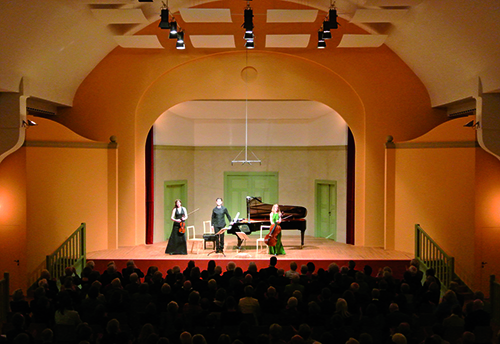
Markus Sittikus Saal Hohenems @ Schubertiade GmbH
The following artists and ensembles will be performing in 2026:
Lieder recitals
Ilker Arcayürek, Erika Baikoff, Kristian Bezuidenhout, Ammiel Bushakevitz, Julius Drake, The Erlkings, Patrick Grahl, Alexander Grassauer, Samuel Hasselhorn, Daniel Heide, Nikola Hillebrand, Christiane Karg, Konstantin Krimmel, Malcolm Martineau, Joseph Middleton, Patricia Nolz, Mauro Peter, Christoph Prégardien, Julian Prégardien, Sophie Rennert, Andrè Schuen, David Steffens, women's choir ‘Vocalis’
Piano recitals
David Fray, Marc-André Hamelin, Adam Laloum, Elisabeth Leonskaja, Igor Levit, Paul Lewis, Francesco Piemontesi, Yaara Tal & Andreas Groethuysen
Chamber concerts
Alinde Quartet, Aris Quartet, Armida Quartet, Guillaume Bellom, Adrian Brendel, Lorraine Campet, Renaud Capuçon, Gérard Caussé, Karel Dohnal, Veronika Eberle, Tobias Feldmann, Till Fellner, Tomás Frantis, Boris Giltburg, Goldmund Quartet, Hagen Quartet, Julia Hagen, Viviane Hagner, Stefan Heinemeyer, Manuel Huber, Javus Quartet, Victor Julien-Laferrière, Harriet Krijgh, Kuss Quartet, Mandelring Quartet, Minetti Quartet, Pavel Nikl, Pavel Haas Quartet, Quatuor Danel, Petr Ries, Matthias Schorn, David Seidel, Lukas Sternath, Premysl Vojta, Ivan Vokác, Dominik Wagner, Jörg Widmann
Choir concert
Feldkirch Chamber Choir, Konstantin Krimmel, Members of the Vorarlberg Symphony Orchestra, Johannes Hämmerle, Benjamin Lack
Angelika Kauffmann Hall, Schwarzenberg
Built in a simple wooden style and expanded in 2001, the 600-seat Angelika Kauffmann Hall is set amid the tranquil meadows and mountains of the Bregenzerwald. It offers perfect acoustic conditions that delight artists and audiences alike and have been praised by the international press with numerous superlatives. The ‘Frankfurter Allgemeine Zeitung‘ ranked it among the three best chamber music halls in Austria, alongside the Mozart Hall at the Vienna Konzerthaus and the Mozarteum in Salzburg, while ‘Die Welt‘ compared it to London's Wigmore Hall. The hall is named after the important painter Angelika Kauffmann (1741-1807), who had close ties to her father's hometown.
Markus Sittikus Hall, Hohenems
The Schubertiade Hohenems concerts take place in the Markus Sittikus Hall, which is nestled in beautiful gardens with fountains and a hedge theatre and can seat 300 people. From the forecourt, visitors have an impressive view of the steeply rising Schlossberg, where the remains of Altems Castle are located. Built in 1913 and listed as a historic monument, the hall was thoroughly renovated by the Schubertiade and today ranks among the most distinguished venues for chamber music and Lied worldwide. It is named Markus Sittikus Hall in memory of Count Markus Sittikus von Hohenems (1574-1619), who, as Prince Archbishop of Salzburg, not only significantly shaped the cityscape with the construction of the cathedral and Hellbrunn Palace, but also established Salzburg's great opera tradition with the first opera performances outside Italy.

Schubertiade museums in Hohenems
Music and cultural history on more than 1,000 m² of exhibition space
As the founding place of the Schubertiade, Hohenems is closely connected to Franz Schubert, even though he himself never set foot in the small town in the Vorarlberg Rhine Valley. The Schubertiade is not only dedicated to his musical work, but no other place has so much to offer about Franz Schubert: the Franz Schubert Museum and the Schubertiade Museum provide an overview of the life and reception history of the great composer in more than 20 historical rooms. Elisabeth Schwarzkopf (1915-2006) was one of the greatest singers of the 20th century, whose illustrious career is documented in numerous recordings that continue to set standards today. Schubertiade GmbH owns the musically and historically important part of her estate and that of her husband Walter Legge, the first and most important record producer in the field of classical music. Items from these collections can be seen in the Elisabeth Schwarzkopf Museum and the Legge Museum. One room of the Legge Museum is dedicated to the theme of ‘Stefan Zweig and the musical life of his time’, as the maternal grandfather of the world-renowned writer was co-owner and resident of this house. The rediscovery of manuscripts C and A in the Hohenems Palace (1755 and 1779) marked the beginning of the success story of the Nibelungenlied, which became the German national epic and was made famous worldwide by Richard Wagner with his four-part music drama ‘Der Ring des Nibelungen’ (The Ring of the Nibelung). This major work by Wagner and other significant adaptations of the Nibelungen theme for stage and film are the focus of the small Nibelungen Museum. And the Schuhmacher Museum displays the components of Karl Nachbauer's shoemaker's workshop (the grandfather of Schubertiade managing director Gerd Nachbauer).
www.schubertiade.at
BENZER HABERLER


-
- ANDANTE ONLINE
- E-Issue
- This month's Andante
- Previous issues
- Point of sales
- Masthead
-
- REVIEW
- Hi-Fi
- Books
- Concerts & Opera
- CD & DVD


